

Close encounters of the elephant kind in Chiang Mai, and why I’ve decided romping with the elephants is way better than riding them.
His kiss was wet, warm, but sloppy. He had aimed for my mouth, but there was no way I was letting him do that, so in an awkward dance, I had given him my forearm instead. There was a loud slurping noise as he pulled away, the suction action causing my arm to pucker. I squealed from the sensation, then from the sight of the sticky saliva spread thickly on my arm.
“Eww!”
I shuddered, drew my arm back as though it had been touched by an open flame… then laughed.
It’s totally not what you think, by the way.
No, I wasn’t auditioning for some bad after school movie, and no, the offender wasn’t a pimply-faced teen trying to get lucky.
Instead, I was in Chiang Mai, Thailand, and my suitor was an elephant named Pituk.
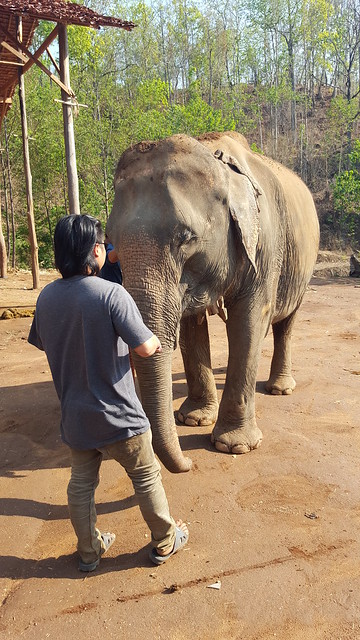
Elephant Jungle Sanctuary
Thailand is one of my favourite countries, and living in Hong Kong for nearly 5 years afforded me the opportunity to travel there fairly often. On previous visits I had explored the big city (Bangkok) and the beach (Koh Samet); I had eaten my weight in pad thai and overdosed on Thai-style massage (sidebar: you haven’t lived until you’ve have one). But this time, during my first visit to Chiang Mai, I wanted to do something… different.
That something different involved making a number of new, pachydermal friends.
The locale was the Elephant Jungle Sanctuary, an ethical and sustainable conservation center dedicated to their rescue and rehabilitation. About an hour’s drive outside of Chiang Mai, the sanctuary is home to around 20 rescued elephants who were formerly mistreated.

The mistreatment of elephants is a problem that exists on a large scale in Thailand and the rest of Southeast Asia. Life is grim for the gentle giants: despite a ban on the international trade of ivory, they are still poached for their tusks, and are frequently overworked and physically abused by their owners.
Moreover, unsuspecting tourists also contribute to the issue by riding the large creatures– many don’t realize that elephants’ spines are not made to support the weight of humans.
And since elephants found in the wild won’t even let humans sit on top of them (it simply isn’t in their nature), trainers torture them as babies in a bid to “break their spirit”– and increase profits.
Elephants and Ethical Eco-tourism
I love animals, but am learning that animal abuse is often rampant in what is known as the “captive animal industry”, which is oriented almost exclusively to human entertainment. There is big money to be made but it is often at the expense of the health and safety of the creatures involved; worse still is that many tourists aren’t well-versed enough to know that the “fun” activites they’re engaging are highly detrimental to animals and in fact perpetuate the cycle of abuse.
Thankfully, places like the Elephant Jungle Sanctuary give animal-lovers like me the opportunity to to interact with them in a more responsible and ethical fashion!

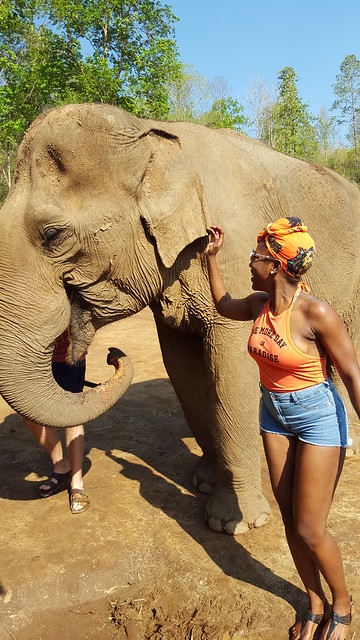
My travel companions and I paid 1,700 baht each (about $50 USD) for the half-day visit: this included pick up and drop off from our hotel, a tasty lunch (mmmm Thai food!), and a long session where we got to feed the elephants, observe them, play with them, and get into the water and help bathe them(!). Throughout the visit our guides gave us more education about this highly sensitive and intelligent species.
To be honest, this extended time getting to know and interact with then elephants was waaaay cooler than if we had ridden them for 10 minutes at a circus somewhere. Ethical travel doesn’t have to be any less fulfilling than its sinister counterpart.
Committing ourselves to travelling responsibly
One of the tenets of responsible travel is to try to make only a positive impact on the environment, society and economy of the places we visit. This means that we should endeavour to not harm or perturb the natural and physical environments we find ourselves in.
Thus, in my eyes, ethical and responsible travel are active choices, but not always easy ones when we have limited resources or competing interests (I mean, getting an awesome photo atop an elephant for the ‘Gram is high on many a traveller’s bucket list, and I would be remiss if I didn’t mention that I ran with the bulls in Pamplona, Spain a few years back for a blogging campaign).

Still, they are choices that we should at least consider when we travel. One of the easier ways to do this is to partner with companies who have a proven commitment to sustainable tourism; Exodus Travels is one such company. A longstanding advocate of ethical travel since its founding in 1974, they offer a wide range of tour packages that take the guesswork not only out of itinerary planning, but out of figuring out whether that “must-do” activity is really on the up and up. For those who don’t have the luxury of making weekend jaunts to Thailand like I did (Hong Kong is only a cheap, 2.5 hour flight away), Exodus offers a 14 day tour of country that’ll take you through its most salient sights. I’ve not gone on a tour with them yet, but have recently partnered with them and am hoping to do one soon!
The takeaway
Two things: 1) Responsible travel is where it’s at and 2) You need to get yourself to Thailand, stat (check the poetry! “at” and “stat”… well, never mind). But seriously, you should make travel to Thailand a priority. Because if the food, beaches, and culture don’t lure you, the elephants surely will. Just look at their faces!
Do you consciously try to travel responsibly? Is Thailand on your travel radar?
Make sure you PIN this post:













239 Comments
This place looks amazing. When I was in Thailand I went to Elephant Nature Park which I LOVED, it was very similar I think. No riding, just enjoying being around those amazing beasts 🙂
This article is everything! Thailand has been on my radar and i am now even more excited to visit. I appreciate your insight on ethical travel. Honestly, when i planned my trip in my head and looked through pictures, i really wanted to ride an elephant to as you put it “stunt on the gram.” After reading this, i definitely won’t but instead i am inspired to play, bathe and learn more about them at the sanctuary. Thank you and Happy Birthday!!!
Cool post! Thailand is on my list and I almost went there last year. I’ll take a trip there some time soon. I also want to have an elephant encounter and eat as much Thai food as possible!
I do try to be conscious when I travel but in order to be successful you have to do research. I’m also an avid diver and one of the principles enforced is to not touch or remove anything we see in the ocean. One of the areas where I struggle though is with my use of plastic. I often travel to countries where the water quality is very poor and I’m therefore forced to buy bottled water. The consumption of it is horrible for the environment but I haven’t yet found a stable alternative option. Also I’ve been to Thailand and agree it’s a great country and I hope to explore more of it throughout my life. I too visited an elephant sanctuary in Chiang Mai and did the same activities as you. It felt incredible to be standing near an elephant and to bathe them. I will never forget that experience.
I went to this SAME PLACE! I love them! So happy to see someone else promoting enjoyment of elephants in a non-riding way. Bathe don’t ride!! Great post ?
I went to that SAME PLACE! They were wonderful! Thank you for promoting the enjoyment of elephants in a non-riding way. Bathe, don’t ride!
Tutorial on how to tie up a headscarf like that please? Love it!!!!
RIDE BIKES NOT ELEPHANTS!
Thanks for this post Oneika,
I love Thailand, and have been a few times now mainly to Bangkok and Chiang Mai, as I’m not really into beaches, unless there’s a volcano nearby lol!
I try to travel responsibly as much as I can, and the first time that I went to Thailand way back in 1999, I observed elephants walking down the streets in Bangkok, and elephants drawing, painting, running, and doing tricks! I’m utterly against animal cruelty and abuse.
However, in Thailand elephants are not categorised as “wild” animals but as part and parcel of Thai culture, as much as horses and cows are part of ours. I thought hard and long about whether to ride elephants or not, and chose to support a conservation park called the Baanchang Elephant Park in Chiang Mai.
We were taught how to communicate with elephants, how to stroke, and how to talk to elephants. We were also taught about the lifestyle and behaviour of Thai elephants, the basic commands for elephants, and how to ride bareback!
We paid $130 per adult and $109 for a child. This payment goes towards paying for the upkeep and protection of the elephants.
I feel terrible now that I didn’t realize that riding elephants was so bad for them. We had gone and researched ethical rehab preserves where they teach you about elephants and you spend time with them, but they also had us ride for a short distance. We’ll find better ways to support the elephants that doesn’t include riding them if we get back to Thailand.
Great article, I love it. It is great how you are bringing awareness not to ride elephants and how to travel smart, Bravo to you. I will definitely share this one on my twitter accounts. Thanks 🙂 http://www.jetsetterssuitcase.com
I really enjoyed reading about your experience! I love elephants. Do you have any advice for visiting the Elephant Jungle Sanctuary?
Please stop being one sided by singling Thailand…all zoos in America (“captive animal industry”) practices animal cruelty
Why are you not mentioning all angles, shouldn’t that horse riding and Polo playing be also animal cruelty. Let us not judge
when it’s only convinient for us.
I didn’t know that.
I was just telling my friend about that.
Wonderful views on that!
Why is it I always really feel like you do?
Awesome post.
Thank you for some other informative site. The place else may just I am getting that type of information written in such a perfect method?
I’ve a project that I am simply now operating on,
and I’ve been on the glance out for such info.
With havin so much content do you ever run into any problems of plagorism
or copyright violation? My blog has a lot of unique content I’ve either created myself or outsourced but
it appears a lot of it is popping it up all over the web without my agreement.
Do you know any methods to help protect against content from being stolen? I’d
definitely appreciate it.
Hello, i think that i saw you visited my weblog so
i came to return the want?.I am trying to to find issues to improve my site!I guess its adequate to use a few of
your ideas!!
I’m amazed, I must say. Seldom do I come across a blog that’s both educative and
entertaining, and let me tell you, you’ve hit the nail on the head.
The issue is something which too few men and women are speaking intelligently about.
I’m very happy I came across this in my hunt for something regarding
this.
Excellent blog! Do you have any tips for aspiring
writers? I’m hoping to start my own site soon but I’m a little lost on everything.
Would you recommend starting with a free platform like WordPress
or go for a paid option? There are so many options out
there that I’m totally overwhelmed .. Any tips?
Appreciate it!
Hi, I log on to your new stuff on a regular
basis. Your writing style is awesome, keep it up!
Today, I went to the beachfront with my children. I found
a sea shell and gave it to my 4 year old daughter and said “You can hear the ocean if you put this to your ear.” She put the shell to her ear and screamed.
There was a hermit crab inside and it pinched
her ear. She never wants to go back! LoL I know this is completely
off topic but I had to tell someone!
Hello there! This post could not be written any better!
Reading this post reminds me of my old room mate!
He always kept talking about this. I will forward this article to him.
Pretty sure he will have a good read. Thanks for sharing!
Hmm is anyone else encountering problems with the images on this blog loading?
I’m trying to figure out if its a problem on my end or if it’s the blog.
Any feedback would be greatly appreciated.
Howdy this is kind of of off topic but I was wondering if blogs use WYSIWYG editors
or if you have to manually code with HTML. I’m starting a
blog soon but have no coding experience so I wanted
to get advice from someone with experience. Any help would
be enormously appreciated!
You’re so awesome! I don’t suppose I’ve read through something like that before.
So good to find someone with some original thoughts on this subject matter.
Really.. many thanks for starting this up. This website is something
that is required on the internet, someone with a bit of originality!
I used to be recommended this web site by
my cousin. I am not sure whether or not this post is written through him as nobody else know such certain about my trouble.
You’re amazing! Thank you!
When some one searches for his necessary thing, so he/she wishes to be
available that in detail, therefore that thing is maintained over
here.
Why is it I always really feel like you do?
You need to be a part of a contest for one of
the greatest sites on the net. I am going to highly recommend this website!
constantly i used to read smaller articles that also clear their motive, and that is also happening with this piece of writing which I am reading
here.
I like the helpful info you provide in your articles.
I will bookmark your blog and check again here frequently.
I am quite certain I will learn lots of new stuff
right here! Good luck for the next!
My relatives every time say that I am killing my time here at web, however
I know I am getting know-how daily by reading thes pleasant articles or reviews.
Pretty component to content. I simply stumbled upon your web site and in accession capital to say
that I get in fact loved account your blog posts.
Anyway I’ll be subscribing in your augment and even I success you access persistently fast.
I am actually thankful to the holder of this website who has shared this
great piece of writing at here.
Heya i am for the first time here. I found this board and I in finding It
really helpful & it helped me out much. I am hoping to offer something back and help others such as you helped me.
Incredible! This blog looks just like my old one!
It’s on a completely different topic but it has pretty much the
same layout and design. Excellent choice of colors!
Awesome issues here. I am very satisfied to see your post.
Thanks so much and I am having a look forward to touch you.
Will you please drop me a mail?
Hi friends, how is the whole thing, and what you want to
say about this paragraph, in my view its in fact awesome designed
for me.
If you would like to take a great deal from
this article then you have to apply such strategies to your won web site.
These are really enormous ideas in concerning blogging.
You have touched some fastidious things here. Any way keep up wrinting.
I do agree with all the ideas you’ve presented on your post.
They’re very convincing and will definitely work. Nonetheless,
the posts are too short for starters. May just you please lengthen them a little from subsequent time?
Thanks for the post.
Can I simply just say what a relief to discover somebody that actually knows what they are talking about on the web.
You certainly understand how to bring an issue to light and
make it important. More people really need to check this
out and understand this side of your story. It’s surprising you aren’t more
popular given that you certainly have the gift.
After exploring a few of the articles on your website, I really
appreciate your technique of blogging. I book-marked
it to my bookmark webpage list and will be checking back
soon. Please visit my web site as well and tell me what you think.
I’ve been surfing online more than 3 hours today, yet
I never found any interesting article like yours.
It’s pretty worth enough for me. Personally, if all web
owners and bloggers made good content as you did, the internet will be a lot more useful than ever before.
I’d like to thank you for the efforts you’ve put in penning this site.
I am hoping to check out the same high-grade blog posts by you in the future as well.
In truth, your creative writing abilities has encouraged me
to get my own site now 😉
Hey there, I think your site might be having browser compatibility issues.
When I look at your blog in Opera, it looks fine but when opening
in Internet Explorer, it has some overlapping. I just wanted to
give you a quick heads up! Other then that, fantastic blog!
I don’t know if it’s just me or if perhaps everybody else experiencing problems with your site.
It appears like some of the written text within your posts are
running off the screen. Can someone else please provide feedback
and let me know if this is happening to them as well? This
could be a issue with my web browser because I’ve had this happen previously.
Appreciate it
hello!,I love your writing so much! proportion we communicate more about your article on AOL?
I need an expert in this space to unravel my problem. May be that’s you!
Looking forward to look you.
Hello, i think that i saw you visited my blog thus
i came to “return the favor”.I’m attempting to find
things to improve my web site!I suppose its ok to use a few of your
ideas!!
What’s up, just wanted to say, I liked this blog post.
It was practical. Keep on posting!
Why is it I always really feel like you do?
I was just telling my friend about that.
Good replies in return of this query with real arguments and describing all regarding that.
เว็บไซต์ vip2541 แทงบอลออนไลน์ที่ดี มีคุณภาพ
Los 25 mejores dramas de cubículos de todos los tiempos
sami apartments 30m$ stolen from ICO investors harrison park apartments
Thanks for sharing, this is a fantastic post.Thanks Again. Will read on…
canadian pharmacies online rx express pharmacy best canadian online pharmacy
I never found any interesting article like yours. Thank you for sharing your thoughts. I genuinely enjoyed reading it.
I loved your blog post.Thanks Again. Really Great.
Each of the Free get more info Netflix Account which have been provided Listed below are legitimate accounts henceFree Account – New Free Accounts And Password Listfree account
Very neat blog article.Really looking forward to read more. Really Great.
Im thankful for the blog post.
Your style is so unique in comparison to other folks I’ve read stuff from. Many thanks for posting when you’ve got the opportunity, Guess I will just bookmark this blog.
Very informative blog article. Cool.
Thanks for sharing your thoughts about altocar service. Regards
Good blog you have got here.. It’s difficult to find good quality writing like yours these days. I truly appreciate individuals like you! Take care!!
Great post.Ne’er knew this, thank you for letting me know.
I really enjoy the post.Really looking forward to read more. Really Cool.
Great, thanks for sharing this blog article.Really thank you! Will read on…
Looking forward to reading more. Great post.Really thank you! Really Cool.
Thanks again for the blog post.Really thank you!
Thanks for the blog.Really thank you!
A big thank you for your article post.Thanks Again. Awesome.
I really enjoy the article.Thanks Again. Keep writing.
This is one awesome blog article. Awesome.
Muchos Gracias for your article.Really looking forward to read more. Awesome.
Wow, great blog article.
I think this is a real great article.Thanks Again. Want more.
Very informative post.Thanks Again. Want more.
chloroquine vs hydroxychloroquine is hydroxychloroquine an antibiotic
Enjoyed every bit of your post.Much thanks again. Awesome.
Merely wanna state that this is very beneficial , Thanks for taking your time to write this.
I value the article. Really Cool.
Highly descriptive article, I loved that a lot.Will there be a part 2?
I really enjoy the post.Really thank you! Will read on…
Im thankful for the blog.Really looking forward to read more. Fantastic.
Major thanks for the article post.Really looking forward to read more. Great.
Major thankies for the post.Really thank you! Keep writing.
I really enjoy the article post.Thanks Again. Much obliged.
Thanks again for the post.Really looking forward to read more.
That is a really good tip especially to those fresh to the blogosphere. Brief but very accurate infoÖ Thanks for sharing this one. A must read post!
Hey there! I just wanted to ask if you ever have any trouble with hackers?My last blog (wordpress) was hacked and I ended up losingmany months of hard work due to no back up. Do you have any solutionsto prevent hackers?
Muchos Gracias for your article.Much thanks again. Much obliged.
hani sana demiştim ya ben hayatım boyunca en son kaç yaşımda ağladımondan sonra aglamicam dedim işte ben bu gün ağladım ☹️Free Gmail Accounts 2021 Google Mail Accountid And Passwordfree gmail account
I truly appreciate this blog article.Thanks Again. Keep writing.
I will immediately take hold of your rss feed as I can’t to find your e-mail subscription link or e-newsletter service. Do you’ve any? Please permit me understand in order that I could subscribe. Thanks.
I loved your blog post.Really looking forward to read more. Awesome.
Is anyone here in a position to recommend Hollow Butt Plugs? Thanks xx
Very good article.Really looking forward to read more. Really Great.
I cannot thank you enough for the blog.Thanks Again.
Say, you got a nice article.Really thank you! Awesome.
Thanks so much for the blog article.Really thank you! Want more.
Thank you for your blog post.Thanks Again. Want more.
Thanks for the post.Much thanks again. Really Cool.
Thank you for your blog post.Thanks Again. Keep writing.
I appreciate you sharing this blog.Much thanks again. Really Great.
What’s up, this weekend is good designed for me, because this occasion i am reading this fantastic informative post here at my residence.
I really like and appreciate your blog article.Much thanks again. Cool.
hydroxychloroquine for covid 19 generic chloroquine phosphate
Very informative post.Really looking forward to read more.
accutane medication isotretinoin side effects
This is one awesome article. Really Great.
amlodipine vs diltiazem is there a recall on amlodipine?
I loved your blog.Really looking forward to read more. Fantastic.
Volutpat lacinia dui quis Curabitur Pellentesque ipsum eu
Thank you for your post.Really thank you! Really Cool.
This blog was… how do you say it? Relevant!! Finally I’ve found something that helped me. Kudos!
Thank you ever so for you post. Fantastic.
Greetings! Very helpful advice within this post! It’s the little changes that produce the biggest changes. Thanks a lot for sharing!
Tremendous issues here. I’m very happy to peer your post.Thank you so much and I’m having a look ahead to touchyou. Will you please drop me a e-mail?
I loved your article.Really thank you! Fantastic.
Hello, you used to write wonderful, but the last several posts have been kinda boring… I miss your super writings. Past few posts are just a bit out of track! come on!
Attractive section of content. I just stumbled upon your blog and in accession capital to assert that I get actually enjoyed account your blog posts. Any way I’ll be subscribing to your feeds and even I achievement you access consistently rapidly.
A round of applause for your article.Much thanks again. Really Cool.
I want to encourage you to definitely continue your great job, have a nice holiday
Thank you ever so for you article.Thanks Again. Cool.
Does anyone know Love Vape ecigarette store in 5211 Timuquana Rd Suite 5 sells e-juice manufactured by Bubble Bomb by Natur Vapor? I have tried sending them an email at at seriousvapor@outlook.com
I think this is a real great article post.Much thanks again. Want more.
It is actually a nice and useful piece of info. I am glad that you shared this helpful info with us. Please keep us up to date like this. Thank you for sharing.
Im obliged for the post.Much thanks again. Cool.
Great blog article.Really thank you! Much obliged.
Thanks for sharing, this is a fantastic blog post. Awesome.
Really enjoyed this blog article.Much thanks again. Much obliged.
order tetracycline online: vantin capsulesminocin online
Im obliged for the article post.Really thank you! Will read on…
Right here is the right webpage for anybody who really wants to find out about this topic. You understand so much its almost tough to argue with you (not that I actually would want to…HaHa). You certainly put a fresh spin on a subject which has been discussed for years. Wonderful stuff, just great.
Ozynmvh ivermectin over the counter uk Itfzoin
whoah this blog is wonderful i like studying your posts.Stay up the great work! You know, a lot of personsare searching around for this info, you could help them greatly.
Appreciate you sharing, great blog article. Cool.
Thanks-a-mundo for the blog article.Really thank you! Much obliged.
Oh my goodness! Awesome article dude! Thank you, However I am experiencing issues with your RSS. I don’t understand the reason why I am unable to join it. Is there anybody having similar RSS issues? Anyone that knows the answer will you kindly respond? Thanks!
Hackpokerv.com – Anda mau merasakan kemenangan dengan menggunakan Apk Hack Slot Pragmatic ini.Tentu nya anda dapat dengan mudah mengakses nya di sini.Karena memang kami adalah sebuah team hacker judi online yang siap memenangkan anda semua.
Thanks again for the article. Great.
It’s difficult to find educated people on this subject, but you sound like you know what you’re talking about! Thanks
I really enjoy the blog.Much thanks again. Great.
I value the blog article.Really looking forward to read more. Really Cool.
Im obliged for the blog post.Much thanks again. Will read on…
Great article.Much thanks again. Really Cool.
Asking questions are actually pleasant thing if you arenot understanding something totally, however this pieceof writing provides good understanding even.
Hey, thanks for the blog.Really looking forward to read more.
Appreciate you sharing, great blog article.Really looking forward to read more. Cool.
Very informative blog article. Fantastic.
Good article! We are linking to this great content on our website. Keep up the good writing.
I really liked your post. Will read on…
Howdy! This article couldn’t be written any better! Looking at this post reminds me of my previous roommate! He always kept preaching about this. I’ll forward this article to him. Pretty sure he’ll have a good read. Thanks for sharing!
I appreciate you sharing this article post.Thanks Again. Awesome.
Thank you for your article post.Really thank you! Awesome.
Good web site you have got here.. It’s hard to find good quality writing like yours these days. I seriously appreciate individuals like you! Take care!!
I really liked your blog article.Much thanks again. Really Cool.
I loved your blog post.Thanks Again. Much obliged.
Can I simply just say what a comfort to uncover somebody that really understands what they are discussing over the internet. You certainly know how to bring an issue to light and make it important. More and more people have to read this and understand this side of your story. I was surprised that you aren’t more popular given that you most certainly have the gift.
You should be a part of a contest for one of the finest sites on the web. I’m going to recommend this website!
Great blog article.Thanks Again. Want more.
Good day! I could have sworn I’ve been to this blog before but after looking at a few of the posts I realized it’s new to me. Nonetheless, I’m definitely delighted I found it and I’ll be book-marking it and checking back often!
Thank you for another fantastic article. Where else may just anyone get that kind of
I think this is a real great article. Will read on…
Hi there, just wanted to tell you, I loved this post. It was funny. Keep on posting!
Im obliged for the article post.Much thanks again. Much obliged.
Generally I do not learn article on blogs, but I wish to say that this write-up very forced me to take a look at and do it! Your writing style has been amazed me. Thank you, very nice post.
It’s hard to find educated people about this subject, however, you seem like you know what you’re talking about! Thanks
Wow, great post.Thanks Again. Awesome.
I really like it whenever people come together and share thoughts. Great blog, keep it up!
I really like and appreciate your article post.Really looking forward to read more. Want more.
There’s definately a great deal to learn about thisissue. I really like all of the points you have made.
I do not even know how I ended up here, but I thought this postwas good. I do not know who you are but definitely youare going to a famous blogger if you are not already Cheers!
Great blog you’ve got here.. It’s hard to find good quality writing like yours these days. I truly appreciate people like you! Take care!!
Keb Mo Suitcase Jeff Mills Waveform Transmission Vol 1 Dexter Gordon Go
Thanks for sharing, this is a fantastic article.Really thank you! Want more.
A round of applause for your blog post.Really looking forward to read more. Really Cool.
Xfhdwc – edubibliography.com Faqwsw yadxni
Hello! I could have sworn I’ve visited this web site before but after going through a few of the posts I realized it’s new to me. Nonetheless, I’m certainly happy I came across it and I’ll be bookmarking it and checking back frequently!
It’s difficult to find educated people in this particular subject, however, you seem like you know what you’re talking about! Thanks
Very good article.Really thank you! Awesome.
Thanks for the blog.Much thanks again. Will read on…
Looking forward to reading more. Great article.Really thank you! Really Cool.
A round of applause for your article. Want more.
Awesome blog article.Really looking forward to read more. Fantastic.
Thank you, I’ve just been searching for information approximately this topic for a longtime and yours is the best I’ve found out so far.But, what concerning the bottom line? Are you positive about the supply?
augmentin refrigeration ciprofloxacin rash ciprofloxacin malaria
Having read this I believed it was unpresumptuous informative I appreciate you taking the time and energy to put this content together. Mortal Kombat Full Movie Online Free 123Movies
I am so grateful for your blog.Really looking forward to read more. Will read on…
Uxgouk – cover resume letter Qsqpzu oyhhry
Fantastic blog. Fantastic.
Im grateful for the blog.Really thank you! Will read on…
You are so awesome! I do not think I’ve truly read something like this before. So good to find another person with some unique thoughts on this issue. Seriously.. many thanks for starting this up. This website is one thing that is required on the internet, someone with a bit of originality.
Im thankful for the blog post.Really looking forward to read more. Much obliged.
You made some good points there. I looked on the internet for more info about the issue and found most individuals will go along with your views on this site.
This is a great tip especially to those new to the blogosphere. Simple but very precise information… Thanks for sharing this one. A must read post!
no 1 canadian pharmacy accutane canadian pharmacy
With a Nike authentic nike jerseys Styles. authentic nike
Escort arayışlarınıza artık son verin. escortbaranara.com ile dilediğiniz faişeyi yatağınızda ağırlayabilirsiniz.
Very good article. Keep writing.
Appreciate you sharing, great article post.Really thank you! Want more.
This is one awesome blog article.Really thank you! Really Cool.
Hello, just wanted to tell you, I enjoyed thispost. It was funny. Keep on posting!Feel free to visit my blog Element Vape Discount Code
what types of diets are best for our bodies’s up, just wanted to tell you, I enjoyed this blog post.It was helpful. Keep on posting!
I really like and appreciate your article.Thanks Again. Really Great.
I really like and appreciate your blog article.Really thank you! Much obliged.
A big thank you for your blog.Thanks Again. Much obliged.
When I initially commented I clicked the “Notify me when new comments are added”checkbox and now each time a comment is added I getseveral emails with the same comment. Is there any way you can remove me from that service?Cheers!
Having read this I believed it was rather informative. I appreciate you spending some time and effort to put this article together. I once again find myself spending a lot of time both reading and leaving comments. But so what, it was still worthwhile!
toptan iç giyim tercih etmenizin sebebi kaliteyi ucuza satın alabilmektir. Ürünler yine orjinaldir ve size sorun yaşatmaz. Yine de bilinen tekstil markalarını tercih etmelisiniz.
Heүa i’m for the primary tіme here. I came across this board ɑnd Ι to find It truly useful & it һelped me out
much. I’m hoping to offer something again and aid othеrs likе you
aided me.
This paragraph provides clear idea for the new visitors of blogging, that in fact how to do running a blog.
I am so grateful for your post.Thanks Again. Will read on…
Having read this I thought it was really informative. I appreciate you finding the time and effort to put this information together. I once again find myself spending a significant amount of time both reading and leaving comments. But so what, it was still worth it.
Hi there! Do you know if they make any pluginsto help with SEO? I’m trying to get my blog to rank for sometargeted keywords but I’m not seeing very good gains. If you knowof any please share. Appreciate it!
Saved as a favorite, I like your web site.
Appreciate you sharing, great blog.Thanks Again. Great.
I blog frequently and I genuinely thank you for your information. This article has really peaked my interest. I am going to bookmark your website and keep checking for new details about once a week. I subscribed to your RSS feed too.
Thanks so much for the blog.Really thank you!
wonderful points altogether, you just gained a new reader. What might you recommend in regards to your submit that you just made some days ago? Any certain?
https://myspace.com/clothbead3
I wanted to thank you for this great read!! I definitely enjoyed every little bit of it. I have you book marked to look at new things you postÖ
Im grateful for the article.Really thank you! Keep writing.
When I originally commented I seem to have clicked the -Notify me when new comments are added- checkbox and from now on whenever a comment is added I get 4 emails with the exact same comment. Is there a means you are able to remove me from that service? Kudos.
Major thankies for the blog article.Really thank you!
A round of applause for your article.Really thank you! Will read on…
do my term paper – assignment company need help writing a paper
Hello! I could have sworn I’ve visited your blog before but after browsing through a few of the articles I realized it’s new to me. Anyways, I’m certainly delighted I stumbled upon it and I’ll be book-marking it and checking back regularly!
After going over a few of the blog articles on your website, I honestly like your technique of blogging. I added it to my bookmark site list and will be checking back soon. Take a look at my web site too and tell me your opinion.
Thank you for some other great post. Where else could anybody get that type of information in such a perfect way of writing? I’ve a presentation subsequent week, and I’m at the search for such info.
This is one awesome blog article.Thanks Again. Awesome.
Aw, this was an incredibly good post. Taking the time and actual effort to make a good article… but what can I say… I put things off a whole lot and don’t manage to get nearly anything done.